Janet Carr posted: " Believe it or not, I was rather groundbreaking in my day. I was one of the first people in Africa to work with the nascent internet, through the university for which I worked. When ARPANET (Advanced Research Projects Agency Network) moved from defe" https://thisbugslife.com
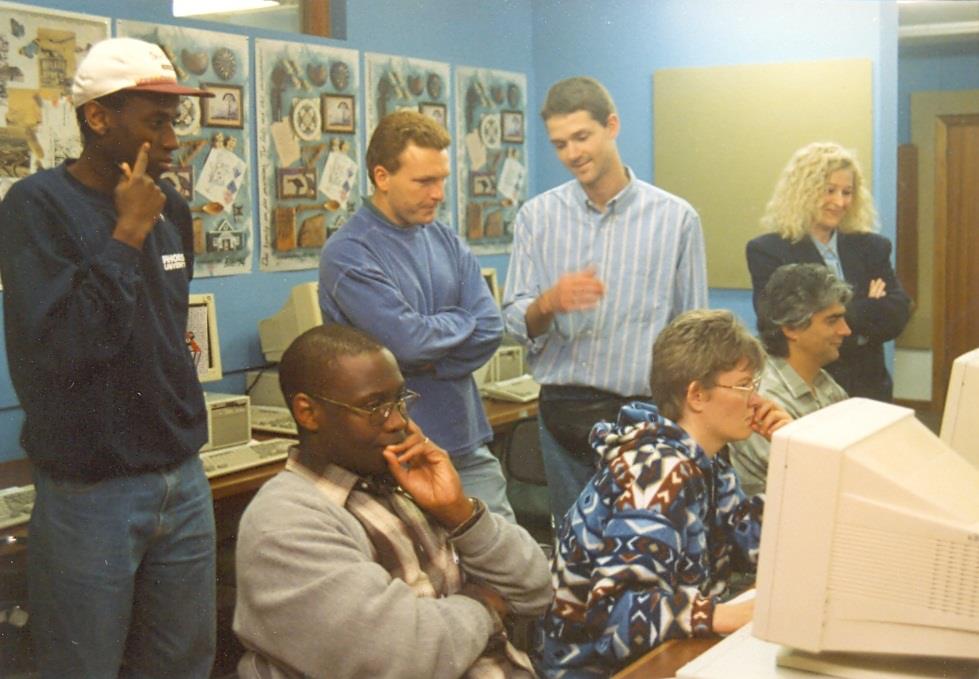
This is the desktop publishing room of Rhodes University's Department of Journalism and Media studies. Here I was teaching the staff how to use Pegasus Mail in around 1994. The Novell server I managed which held all the mail was called Thoth (held to be the inventor of writing, the creator of languages, the scribe, interpreter, and adviser of the gods)
Believe it or not, I was rather groundbreaking in my day. I was one of the first people in Africa to work with the nascent internet, through the university for which I worked.
When ARPANET (Advanced Research Projects Agency Network) moved from defence researchers to academics and then to what we now know as the internet, no one was really interested. I managed the Usenet newsgroups and tried (and often failed) to get people to use email. No one wanted to use email because no one else had email. Sometimes I had to send a fax to someone to tell them they had an email. The newsgroups I managed were mainly hardcore researchers or sci-fi fans. There was also rec.pets.cats quite early, which shows cat crazy people are everywhere!
When the first graphic interface arrived (hello Windows, goodbye DOS) our university was the first in Africa to create websites. Not one company was interested because there was no money in it.
When I moved from IT back to journalism to use these new skills, I can remember begging newspapers to allow my students to create online versions for them. No one was interested because the concept of giving news away for free was totally foreign. In the end the first online newspaper in Africa was GRAB, a small township newsletter. Literally no one else was interested.
Slowly though, the students in my CARR (Computer Aided Research and Reporting) honed their skills in researching the different international databases and using manual html. When the newspapers woke up they were lining up to employ my students, who had skills we now take for granted. A colleague, Brett Lock, came up with Gogga, which was a forerunner to Google News, but for African newspapers.
We had a visitor from the US once who was impressed at how a tiny university in a small town in South Africa was going global. He said to me 'you are very lucky. It is not often that man can watch a global change like this happen. Everything is totally new territory' I have never forgotten that.
I was interviewed for a national newspaper in 1998. Complete article is here if anyone is interested
Our first thought was democracy and freedom of speech and information. And of course there is STILL that. Getting news out quickly despite news blackouts. Watching news break via media such as Twitter/X (what's left of it)
But what not one of us saw coming was
shorter attention spans for the consumption news and information (the rise of TikTok)
people reading fewer articles, preferring video
YouTube
trolls and bullying
scams
misinformation and rumours
fake news
digitally created photographs being indistinguishable from the real thing






No comments:
Post a Comment